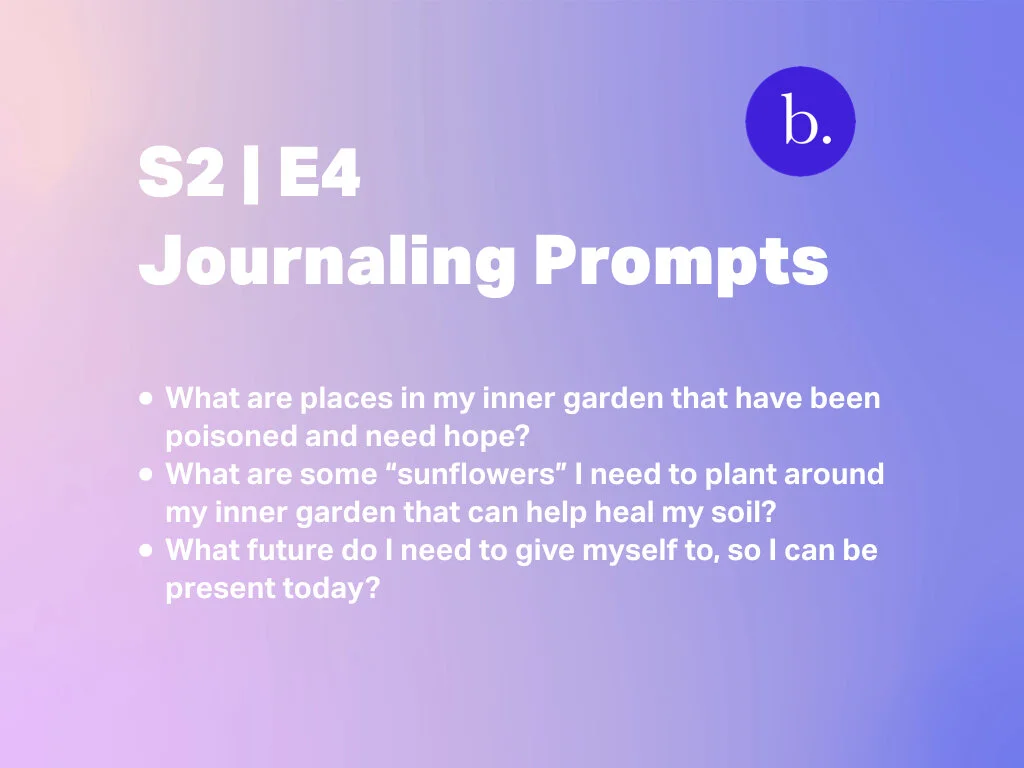
S2 | E4 Soil: Healing with Hope
Hello again my friend,
So,
If you have a piece of land waiting to be cultivated for your garden, you have to analyze the soil. Now that you’ve taken ownership of your inner garden, accepted your climate zone, and decided to welcome and work with the seasons, now you have to take a good look at your soil.
Is it healthy? Is it in good condition to grow things?
Soil is where the life is.
On the outside… this is the stuff we call dirt. For our inner worlds, it’s our mind, our heart.
There’s the famous parable of the soils: A farmer goes out to cast his seeds and the different soils affected the growth. There was the side of the road, the rocky ground, the weeds, and the good ground. And the metaphor the soils represented the varying states of the human heart.
Last year I was watching a Masterclass on gardening and Ron Finely explained the different soils: There’s the compacted: the only thing that can grow is weeds, because it has no water retention. There the clay: holds too much water and it doesn’t release it which is bad for your plants, so it’s muddy, Sand is good for succulents because it loses a lot of water, but not great for other plants… Then there’s the loamy Soil: It’s a combination of all the soils. Sand, silt, a small amount of clay, it holds moisture but is also breaks up.
The roots of the plants don’t have to fight through the soil, they don’t have to use energy to fight to get through the soil, they use that energy to feed the plant and give fruit, and the bigger your roots are, the healthier your plant is. So, just because you have soil in your yard does not mean it’s fit for healthy plants. You have to get it to a place where it can thrive.
So, Ron Finely suggests that you get a kit and test your soil to see if it’s toxic. What happens if your soil is toxic, what do you do?
Apparently you can plant sunflowers to pull the poison out of the soil. After the Fukushima nuclear disaster in Japan, they planted sunflowers all over the town to soak up all the radiation. Sunflowers are cleaners of the environment. What a gift. What a beautiful gift to our human disasters. These sunflowers brought hope back to this town. They healed the environment so life could continue.
There are many things that can come in and poison your soil. Cynicism can be a toxin that doesn’t allow anything to grow. Last week I compared it to being in a perpetual state of winter, and sometimes you can let the ice and snow thaw, and the soil still needs some attention, because trust takes a long time to develop. It’s not a 'flip the switch kind' of a thing. The antidote to cynicism is hope. Hope that something beautiful can happen to your garden. A feeling of trust that you will be ok.
I love that the flower that heals the environment is a big bright yellow sunflower. It’s such a statement.
Because hope really is an optimistic state of mind. Hope feels a little cheesy to us who are jaded, we roll our eyes like intellectual realists at the earnestness that hope presents itself with. Legend has it that the following quote was found written on a cellar wall in Germany during the holocaust: “I believe in the sun even when it is not shining. I believe in love even when I cannot feel it. I believe in God even when he is silent.”
You see, Hope isn’t about sunshine, rainbows, and sprinkles.
Hope is actually hard core.
Hope soaks up radiation from a nuclear disaster. If your life is going as planned, and it’s comfortable, you don’t need hope. You don’t need much. Hope is needed in the dark places, where there’s poison, toxins, hope matters for the cynical who don’t see any light at the end of the tunnel, for those who have given up, the ones who don’t feel like getting up one more time.
You may have some healthy soil in parts of your garden, but there are little places you haven’t paid attention to that need a little healing, a little hope, perhaps some sunflowers. You cannot grow a healthy inner garden without some hope, because Hope summons the future… and planting a garden is about providing or designing something for the future. Where have you lost some hope, or feel like you’re losing hope? It’s time to reinstate some sunflowers to brighten these corners.
This can come in the form of new friends, better habits, a new environment, a new strategy, a new journaling practice, a spiritual ritual. I don’t know what that is for you, but I hope you’ll take the time to figure it out. Hope is important for the future, and for the present, it allows us to continue one day at a time.
One of the best descriptions of Hope I’ve ever read was written by Rebecca Solnit:
And that’s what I’ll leave you with:
“Hope is not a lottery ticket you can sit on the sofa and clutch, feeling lucky. It is an axe you break down doors with, in an emergency. Hope should shove you out the door, because it will take everything you have to steer the future away from endless war, from the annihilation of the earth’s treasures and the grinding down of the poor and marginal… To hope is to give yourself to the future—and that commitment to the future is what makes the present inhabitable.” — Rebeca Solnit